

Table of Contents
- What a Modern Electronic Retail Store Actually Stocks
- Pricing Breakdown: What You Pay for Each Product Type
- Electronics Store Return Policies Compared
- Electronics Store Price Matching: How It Works
- Online vs In-Store Electronics Shopping
- Ecosystem Compatibility and Long-Term Care
- Conclusion: Choosing the Right Electronic Retail Store
- Frequently Asked Questions
Last Updated: September 14, 2026
What a Modern Electronic Retail Store Actually Stocks
The US consumer electronics stores industry is projected to stabilize in 2026 with modest revenue growth of 1.6%, reaching $199.5 billion, according to IBISWorld's consumer electronics stores industry analysis. That figure hides a wide gap: some electronic retail store shelves move fast, while others sit on inventory nobody wants. At TechyDealy, we watch which categories actually turn over, and the pattern is consistent. A modern electronics store is less a warehouse of gadgets and more a curated showroom, organized around how people actually live and work.
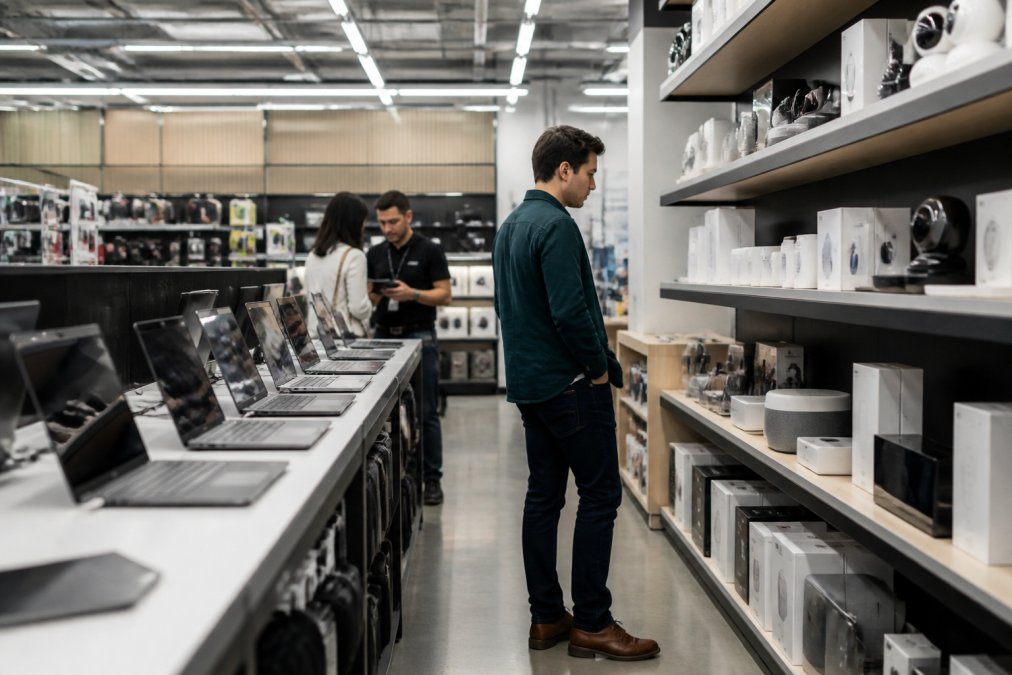
Computing, Audio, and Smart Home Categories
Computing hardware anchors most floor space: laptops, tablets, monitors, keyboards, and mice for remote workers and students. Audio follows close behind, from budget earbuds to noise-canceling headphones. Smart home devices round out the core, covering security cameras, video doorbells, smart plugs, and voice assistants.
A common mistake is assuming every store carries the same depth in each category. In practice, the best-stocked electronic retail store balances high-end equipment with budget-friendly tech so shoppers can compare without leaving the aisle.
Gaming, Wearables, and Accessories
Gaming consoles, controllers, and retro handhelds draw a younger crowd, while wearable technology like fitness trackers and smartwatches appeals to commuters. Accessories, cables, chargers, and stands, generate steady repeat business because they wear out or get lost.

The category that surprises most shoppers is peripherals. A wireless gaming mouse with adjustable DPI or a foldable Bluetooth keyboard can matter more to daily use than the laptop itself.
Pricing Breakdown: What You Pay for Each Product Type
Pricing in electronics retail varies sharply by category, and understanding the spread helps you spot a fair deal. Budget-friendly tech rarely drops below a floor because margins are thin, while high-end equipment carries wider swings between stores.
| Product Type | Typical Range | What Drives the Price |
|---|---|---|
| Audio earbuds | $15-$60 | Noise cancellation, battery life |
| Gaming accessories | $12-$60 | DPI, build material, RGB |
| Retro consoles | $45-$90 | Storage, emulator support |
| Charging stations | $20-$150 | Port count, battery capacity |
| Car multimedia | $150-$250 | Screen size, wireless CarPlay |
At TechyDealy, a pair of LED Display Noise-Canceling Bluetooth Earbuds runs $17.99, while the Drive Smart 10.26-Inch Wireless CarPlay player sits at $200.99. The gap is not random. Screen size, wireless connectivity, and included cameras all push cost upward.

Electronics Store Return Policies Compared
Electronics store return policies are the terms that determine whether you can send a product back, how long you have, and who pays for shipping. Most national chains cluster around a 15 to 30 day window, but the details, restocking fees, open-box rules, and who covers return shipping, decide whether a return is painless or a headache.
How the Major Retailers Actually Compare
A few patterns hold across the big-box and membership players:
- Best Buy runs a 15-day standard window, with a shorter window for activatable devices like phones and tablets. Members of its paid loyalty tier get extended windows. Opened drones, major appliances, and some large TVs can carry a restocking fee.
- Walmart generally offers 90 days on most electronics but shortens that to 14 or 30 days for computers, cameras, drones, and cell phones. Marketplace sellers set their own rules, which is where most confusion starts.
- Target uses a 30-day window for most electronics, with a shorter window for Apple products and some mobile devices.
- Costco is the outlier: no fixed deadline on many electronics, but computers, tablets, cameras, and TVs fall under a 90-day limit, and the membership fee is refundable separately.
- Amazon varies by seller. Items shipped and sold by Amazon follow a 30-day window; third-party sellers post their own terms on the listing page.
The Rules That Trip People Up
Return windows vary by product type. Opened earbuds and software often fall outside standard coverage for hygiene or licensing reasons, while unopened accessories usually qualify for a full refund. A hassle-free returns policy refunds the full purchase price rather than issuing store credit.
Three mechanics matter more than the headline window:
- Restocking fees. Large TVs, drones, and some open-box computers can carry a 15% deduction. Ask before you buy, not after.
- Receipt vs. account lookup. Most chains can pull a purchase from a loyalty account or credit card, but only within the original window. Without either, you may be capped at store credit.
- Return shipping. Online orders from big-box stores are usually free to return in-store but may cost $6-$15 if you ship them back.
When a Return Is Denied
If a retailer refuses a return that you believe falls inside its posted policy, the escalation path is straightforward. Ask for the policy in writing, then file a complaint with your state attorney general's consumer protection division. The Federal Trade Commission's FTC guidance on refunds and returns notes that a seller's posted return policy is binding, and that sellers who fail to disclose "no refunds" before purchase can be held to a refund. For online orders, the FTC's Mail, Internet, or Telephone Order Merchandise Rule gives you additional leverage if the item never shipped or arrived materially different from the description.
A Note on Long-Term Value
The return window is really a proxy for how much risk the retailer is willing to absorb on your behalf. A store with a 15-day window and a restocking fee is telling you it expects you to be certain before you buy. When two stores price the same laptop within a few dollars, that difference in risk transfer is often worth more than the price gap.
Electronics Store Price Matching: How It Works
Electronics store price matching is a policy where a retailer refunds the difference if you find the same item cheaper elsewhere, usually within a set window after purchase. The catch is that most policies exclude marketplace sellers, clearance items, and membership-only pricing.
To use price matching well, follow a short checklist:
- Confirm the competitor item is identical in model number and condition
- Check whether the policy covers online-only prices
- Note the window, often 7 to 14 days after purchase
- Keep your receipt and a screenshot of the lower price
- Ask before the item ships if you are buying online
Automated pricing tools have changed how aggressively stores respond. One Omnia Retail case study on automated pricing found that a client cut its dependence on manual price changes and improved both the frequency and accuracy of its adjustments. That means price matching is more competitive than it used to be, but also more conditional.
Online vs In-Store Electronics Shopping
Online vs in-store electronics shopping comes down to what you value more: hands-on testing or convenience. Physical stores still create distinct value in a digital economy through omnichannel integration and retail analytics, according to Harvard Business Review's analysis of physical retail.
In-store shopping wins when you need to feel a keyboard, test a monitor's color, or compare two laptops side by side. Online wins on price transparency, inventory depth, and same-day delivery or in-store pickup options that let you skip the trip entirely.
The friction point is real. A 2026 survey found that 79% of retailers report associates must leave a customer's side to access store systems, and that gap contributes to 48% of shoppers walking out without buying, per X-hoppers US consumer retailer report. Online stores sidestep that problem, but they cannot let you hold the product first.
Ecosystem Compatibility and Long-Term Care
Compatibility is where most smart home setups fall apart. A camera that only works with one app, a charger that only fits one port type, and a speaker that ignores your existing assistant all create the troubleshooting nightmare shoppers dread. No major retailer publishes a real guide to this, which is why it is the single most useful thing an electronics store can teach a customer.
The Three Protocols That Decide Everything
Before buying any connected device, identify which of these it speaks:
- Wi-Fi (2.4 GHz vs. 5 GHz). Most smart plugs, cameras, and bulbs only join 2.4 GHz networks. If your router broadcasts a single merged SSID, setup will fail until you split the bands in the router admin panel.
- Bluetooth and Bluetooth LE. Fine for a single phone-to-device link, but it does not mesh. A Bluetooth lock cannot be controlled from another room.
- Zigbee and Z-Wave. Low-power mesh protocols that require a hub, SmartThings, Hubitat, or a manufacturer bridge. They are more reliable at scale but add a $50-$150 box to the bill.
- Matter and Thread. The newer cross-brand standard. Matter-certified devices are designed to work across Apple Home, Google Home, Amazon Alexa, and Samsung SmartThings. Thread is the low-power radio many Matter devices use, and it needs a Thread border router, which some newer smart speakers and hubs already contain.
Building a Setup That Does Not Lock You In
A practical rule: buy the hub first, then the devices. If you standardize on Matter and Thread, you can mix brands without losing control when one manufacturer discontinues its app. If you standardize on a single brand's ecosystem, you get tighter integration but you inherit that company's roadmap risk.
For a workstation rather than a home, the same logic applies to ports. A USB-C dock with Power Delivery, DisplayPort Alt Mode, and at least one USB-A port will outlive three laptops. A dock that only does data will be obsolete the moment you upgrade.
Extending the Life of What You Already Own
Most electronics do not die, they are abandoned. Three maintenance habits change that:
- Battery health. Lithium-ion cells degrade fastest when held at 100% in heat. Keeping a laptop between 20% and 80% on a desk charger, and storing power banks at roughly half charge, can add years of usable capacity. Apple, Dell, and Lenovo all ship battery-health limiting features in their settings menus.
- Thermal hygiene. Dust in a laptop fan or a console vent is the leading cause of thermal throttling. Compressed air every six to twelve months is the cheapest performance upgrade available.
- Firmware and security updates. A router or camera that stopped receiving updates two years ago is a future paperweight, and a security liability. Check the manufacturer's support page for the last firmware date before you buy.
What to Do With the Old Gear
The Environmental Protection Agency's EPA guidance on electronics donation and recycling notes that electronics are the fastest-growing category of municipal waste and that most of what people discard is still functional or repairable. Practical options, in order of preference:
- Trade-in. Apple, Samsung, Best Buy, and GameStop all run trade-in programs that convert old devices into credit.
- Manufacturer take-back. Dell, HP, and Lenovo accept their own hardware for recycling, sometimes with a prepaid shipping label.
- Municipal e-waste events. Most counties run periodic collection days; check your county's public works page.
- Retailer drop-off. Best Buy accepts most consumer electronics for recycling at no charge, regardless of where you bought them.
Conclusion: Choosing the Right Electronic Retail Store
The right electronic retail store is the one that matches your priorities, whether that is price matching, a generous return window, or same-day pickup. The category is growing again, but the differences between stores matter more than the headline numbers suggest.
TechyDealy is built for shoppers who want that clarity. We offer complimentary ground shipping on every order, a hassle-free return policy with a full purchase price refund, and a curated selection of reliable gadgets and laptops, from ergonomic desk tools to smart monitoring devices. If you have been burned by a store that made returns difficult, that policy is the difference.
Get started with TechyDealy and shop smart essentials backed by free shipping and returns you can actually use.
Frequently Asked Questions
What should I look for when choosing an electronic retail store?
Focus on four things: return window length, price matching policy, warranty coverage, and whether the store stocks the full ecosystem you need. A store with a 30-day return window and written price matching beats one with lower sticker prices but restrictive policies. Check if the retailer carries compatible accessories for your devices so you avoid shopping at three different places for one setup.
Are online-only electronic stores safer than brick-and-mortar?
Both carry risk, but the protections differ. Online stores typically offer longer return windows and free return shipping, while physical stores let you inspect items before purchase. In 2026, 79% of retailers report associates must leave a customer's side to access store systems, contributing to 48% of shoppers walking out without buying. Online eliminates that friction but removes the hands-on test. Choose based on whether you need to see the product first.
How do electronics store return policies usually work?
Most electronics store return policies fall into two tiers: 15-day windows for opened items and 30 to 90 days for unopened products. Restocking fees of 10% to 15% apply to drones, large appliances, and some gaming gear. Always confirm whether return shipping is free and whether refunds go to original payment or store credit. TechyDealy offers hassle-free returns with full purchase price refunds and complimentary ground shipping on every order.
Does price matching actually save money on electronics?
Price matching saves money when you find a lower advertised price at an authorized dealer within the match window, usually 7 to 30 days after purchase. The catch: most policies exclude marketplace sellers, members-only pricing, and flash sales. Bring the competitor's current ad or link to customer service. If the store does not offer price matching, ask about price adjustment policies instead, which credit you the difference if the item drops in price after you buy.
What is the best store to buy electronics in 2026?
The best electronic retail store depends on what you value most. For hands-on testing and same-day pickup, a physical location wins. For selection and free shipping, online retailers lead. In 2026, US consumer electronics stores are projected to reach $199.5 billion in sales, and 35,280 stores operate nationwide, so competition keeps pricing tight. Compare return policies and price matching before committing to one retailer for your entire setup.