

Table of Contents
- What to Know Before Buying a C Portable Air Conditioner
- Portable Air Conditioner BTU Calculator: Sizing Your Room
- How to Vent a Portable Air Conditioner
- Portable Air Conditioner vs Window Unit
- Energy Efficiency and Real Operating Costs
- Noise Levels, Smart Features, and Maintenance
- Conclusion
- Frequently Asked Questions
Last Updated: September 27, 2026
What to Know Before Buying a C Portable Air Conditioner
The portable air conditioner market hit $1.43 billion in 2026 and is projected to reach $5.04 billion by 2035, a 15% compound annual growth rate, according to Business Research Insights market analysis. That growth tells you something: more people are choosing a c portable air conditioner over permanent installations. This guide from TechyDealy breaks down the specs that actually matter, from BTU sizing to real energy costs, so you buy the right unit the first time.

Single-Hose vs Dual-Hose Models
A single-hose portable air conditioner pulls air from inside your room, cools it, and exhausts some outside, creating negative pressure that pulls hot outside air back in through gaps. Dual-hose models draw intake air from outside, so cooled air stays put.
Portable Air Conditioner BTU Calculator: Sizing Your Room
Use this formula: multiply your room's square footage by 20 to get a baseline BTU requirement. A 300-square-foot room needs roughly 6,000 BTU. Add 600 BTU for each person beyond two, and 4,000 BTU if the room gets direct sun.
| Room Size | Baseline BTU | With Sun Exposure |
|---|---|---|
| 150 sq ft | 5,000 | 8,000 |
| 250 sq ft | 6,000 | 9,000 |
| 350 sq ft | 8,000 | 12,000 |
| 450 sq ft | 10,000 | 14,000 |
Square Footage Coverage and Cooling Capacity
Manufacturers often overstate coverage: a unit rated for 400 square feet may struggle in a 400-square-foot room with vaulted ceilings or west-facing windows. Check the DOE rating, not the marketing label.
How to Vent a Portable Air Conditioner
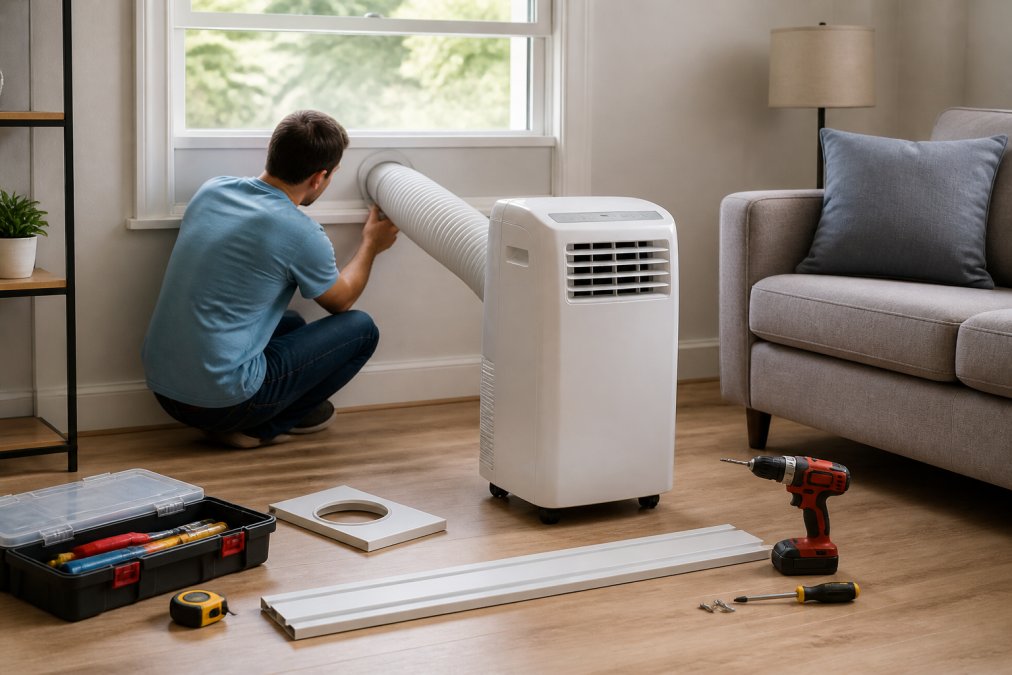
Venting requires a window kit that seals your exhaust hose into an open window. Most kits include adjustable panels for standard double-hung and sliding windows; setup takes 15-20 minutes.
Window Type Compatibility and Kit Options
Casement windows, which crank open outward, need specialized kits sold separately. Sliding windows work with standard panels; awning windows are hardest to seal and often need custom solutions.
Portable Air Conditioner vs Window Unit
Window units win on efficiency and price, cooling better per watt for less upfront. Portable units win on flexibility: no permanent installation, no landlord approval, and easy room-to-room movement.
Energy Efficiency and Real Operating Costs
A wattage figure means nothing until you convert it into dollars on your own electric bill. Here is the math, plus the labeling details that separate efficient units from well-marketed ones.
The Formula You Can Run Yourself
Monthly cost = (watts ÷ 1,000) × hours used per day × 30 × your electricity rate.
- 1,150 ÷ 1,000 = 1.15 kW
- 1.15 kW × 8 hours = 9.2 kWh per day
- 9.2 kWh × 30 days = 276 kWh per month
- 276 kWh × $0.16 = roughly $44 per month
EER, CEER, and the DOE Label
The U.S. Department of Energy's appliance efficiency standards rate portable air conditioners on EER (Energy Efficiency Ratio), which is BTU output divided by watts drawn. A 10,000 BTU unit drawing 1,000 watts has an EER of 10. The same output at 1,250 watts has an EER of 8.
Two things trip buyers up:
- Portable units run lower EER than window units. A window unit may hit EER 11-12; a comparable portable often lands at 7-9 because the compressor, condenser, and evaporator share one box and fight for air, the efficiency trade-off you accept for portability.
- The DOE test procedure changed. The amended federal test procedure tightened how BTU ratings are measured, so a unit labeled 10,000 BTU today may not match one sold under the older test. Across model years, trust EER and measured wattage over the headline BTU number.
What Actually Drives Your Bill
Three levers, in order of impact:
- Hose configuration. Dual-hose units avoid the negative-pressure problem that pulls hot outside air back in, so the compressor cycles less, the single biggest efficiency factor for a portable.
- Sizing accuracy. An oversized unit short-cycles and dehumidifies poorly; an undersized unit runs continuously and never catches up. Match BTU to measured room size using the calculator above.
- Run hours and setpoint. Every degree you raise the setpoint cuts runtime. Running the unit only when the room is occupied, via the timer covered below, can cut monthly cost by a third or more.
Reading the Label Without Getting Fooled
Ignore "eco mode" and "energy-saving" badges unless they come with a wattage figure. The numbers that matter:
Portable Fan Air Conditioners USB →
- Rated cooling capacity in BTU (measured under the current DOE procedure)
- Power input in watts (or amps × volts)
- EER (BTU ÷ watts)
Noise Levels, Smart Features, and Maintenance
Noise determines whether you can sleep next to the unit, smart features how you control it, and maintenance whether it still works in year three. Most retail listings cover none of the three well.
Decibels, Translated
Manufacturers quote a single dB figure, usually measured at the lowest fan speed in a quiet room, not what you hear at full blast. A practical scale:
- 30 dB, a quiet bedroom at night
- 40 dB, a library reading room
- 50 dB, a residential refrigerator hum or light rainfall
- 55 dB, a normal conversation at three feet
- 60 dB, a dishwasher running in the next room
- 65 dB+, a vacuum cleaner; you will raise your voice to talk over it
Smart Features Worth Paying For
Wi-Fi and app control are standard on mid-range and premium units. The features that actually change how you use the machine:
- Programmable 24-hour timer, start the unit 30 minutes before you get home and shut it off two hours after you fall asleep. The single biggest energy saver on the list.
- Sleep mode, raises the setpoint by 1-2 degrees per hour, cutting compressor runtime without waking you.
- Auto-restart after power loss, resumes previous settings when the grid comes back. Matters in storm-prone areas.
- Remote control and digital display, check whether the display dims or turns off; a bright LED panel in a dark bedroom is a real complaint.
- Auto-swing louvers, distribute air across the room instead of blasting one spot. Cheap and genuinely improves comfort.
Filter Cleaning: The Ten-Minute Job That Doubles Lifespan
A clogged filter is the most common cause of a portable air conditioner that "stopped cooling." Restricted airflow forces the compressor to run longer and hotter, raises your energy bill, and can trip the overheat protection.
How to clean the filter:
- Unplug the unit. Always.
- Locate the filter, usually a mesh panel behind the front intake grille, sometimes behind a removable rear panel. Check the manual; some models have two.
- Slide or lift the filter out. Most are not screwed in.
- Vacuum the loose dust with a brush attachment, then rinse under lukewarm water. Never use hot water or detergent, it warps the mesh.
- Let it air-dry completely. A damp filter grows mildew and smells.
- Reinstall and run the unit on fan-only for ten minutes to confirm airflow.
Condensate Drainage: Tank vs. Continuous
A portable air conditioner pulls water out of the air as it cools. How that water leaves determines how much babysitting the unit needs.
- Manual tank. The unit collects condensate internally and shuts off when full. In a humid climate that can mean emptying it once or twice a day, fine for dry regions, a chore in the Southeast.
- Continuous gravity drain. A hose runs from the drain port to a floor drain, bucket, or outside, so the unit never shuts off from a full tank. Requires the unit to sit above the drain point.
- Condensate pump. For units below the drain point, a small pump lifts water up and out. Quieter and more convenient, but adds a part that can fail.
How to drain the tank:
- Unplug the unit and let it sit a few minutes so water settles.
- Place a shallow pan under the drain port, the plug releases more water than you expect.
- Remove the plug or cap and drain fully.
- Reinstall the plug firmly before restarting; a loose plug leaks across your floor.
A Note on Storage
At season's end, run the unit on fan-only for an hour to dry the internal coils, drain the tank, clean the filter, and store it upright with the hose coiled loosely. Storing a damp unit on its side is how mold gets a foothold.
Conclusion
Choosing the right portable air conditioner comes down to matching BTU to your actual room size, checking window compatibility, and accepting the efficiency trade-off that comes with portability. Get those three right and you avoid the most common buyer's regret.
Frequently Asked Questions
Is it worth buying a portable AC?
It depends on your space and constraints. Portable air conditioners work well for renters or rooms without window-unit compatibility, and modern models like the Midea Duo MAP14S1TBL reach noise levels around 49 decibels, dropping to 42 decibels in sleep mode (Forbes Vetted, 2026). The trade-off is lower efficiency than window units. If you can install a window unit, that option cools faster and costs less to run. If you need flexibility, a portable air conditioner is worth it.
How do I calculate the BTU needed for my room size?
A portable air conditioner BTU calculator starts with square footage. As a baseline, you need roughly 20 BTU per square foot of living space. A 300-square-foot bedroom needs about 6,000 BTU, while a 500-square-foot living area needs around 10,000 BTU. Adjust upward for south-facing windows, kitchens, or rooms with poor insulation. Oversizing wastes energy; undersizing leaves you warm. Match the unit's cooling capacity to your actual room dimensions.
Do all portable air conditioners need to be vented out a window?
Yes, single-hose and dual-hose portable air conditioners need window venting to exhaust hot air. Without a vent, the unit recirculates heat back into the room. Most models include a window kit with adjustable panels that fit standard double-hung and sliding windows. If your window type is incompatible, you may need a custom panel or a different cooling solution. Units that run without venting, like evaporative coolers, are not true air conditioners.
Are portable air conditioners energy efficient?
Portable units are less efficient than window or central air systems. The SereneLife SLPAC10 was measured at $132 in energy costs over 90 days (Sensibo, 2026), which is competitive for its class. The U.S. Department of Energy amended test procedures in 2023 to improve energy conservation standards (Federal Register, 2023). Look for units with higher EER ratings. An EER of 7 or 8 is at the lower end; higher numbers mean lower operating costs.