

Table of Contents
- Why Budget Alternatives Are Winning in 2026
- How to Choose a Budget Smartphone
- Top Budget Alternatives to Flagship Phones
- Refurbished Flagship Phone Pros and Cons
- Smartphone Warranty and Return Policies
- Essential Accessories for Your New Phone
- Frequently Asked Questions
Last Updated: September 26, 2026
Why Budget Alternatives Are Winning in 2026
The best budget alternatives to flagship phones have become the smartest buy in tech. ZDNet's 2026 market analysis found that this year's flagship launches were widely called "underwhelming," with price hikes on top, pushing shoppers toward discounted 2025 flagships and strong mid-range models instead. At TechyDealy, we see the same pattern in what customers actually order.
The math is simple. Flagship prices climbed while upgrades shrank. Meanwhile, testing from PCMag's budget phone picks shows affordable devices now deliver reliable software support, durable designs, and competitive cameras. Android Authority's 2026 testing reached the same conclusion: most users simply do not need to spend flagship money.
That shift is why budget alternatives deserve a real look, not a consolation prize.
How to Choose a Budget Smartphone
Choosing a budget smartphone comes down to matching specs to your daily habits, not chasing the biggest number on a spec sheet. The mid-range category, roughly $300 to $700 according to Tech Advisor's market segmentation, is where value peaks.
Start with these four questions:
- How many hours of screen time do you actually use per day?
- Do you game, or mainly browse, stream, and message?
- How long do you plan to keep the phone?
- Which carrier or unlocked device fits your plan?
Prioritize the Specs That Matter Daily
Battery capacity and software update commitments matter more than megapixels for most people. A phone that gets security patches for five years beats one with a sharper camera that stops updating in two.
Look for an OLED display with a 90Hz or higher refresh rate, at least 6GB of RAM for smooth multitasking, and 5G connectivity if you keep phones for three years or more. Optical image stabilization helps more than a high megapixel count in low light.
Top Budget Alternatives to Flagship Phones
The top budget alternatives to flagship phones in 2026 are the Samsung Galaxy A17 5G, the Google Pixel 10a, and the Nothing Phone (a) Pro. Each targets a different priority: overall value, battery life, and camera quality.
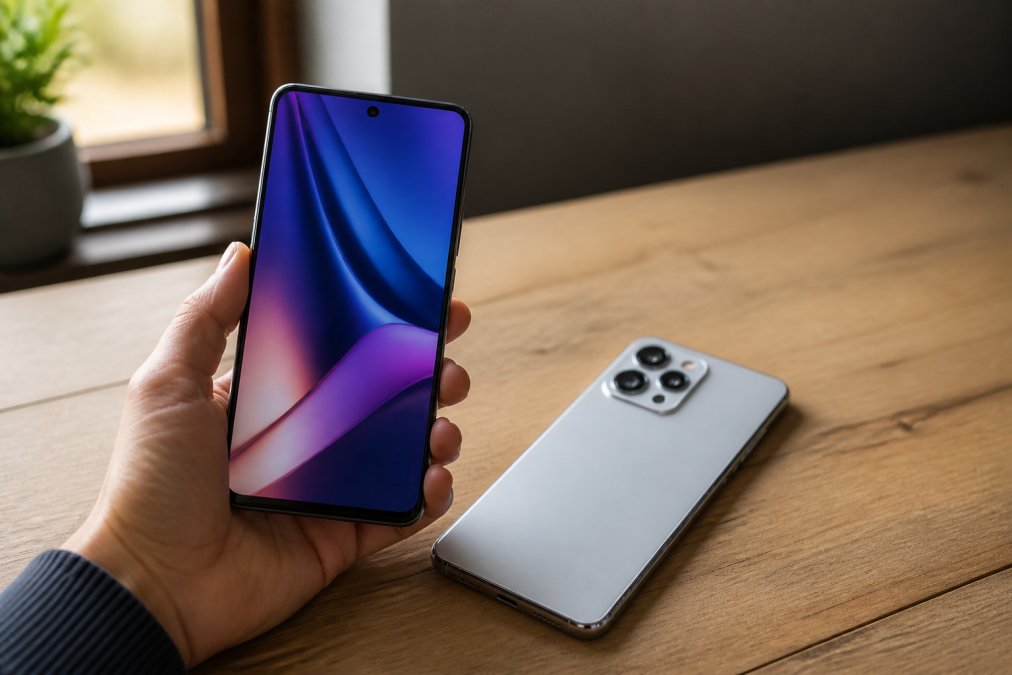
Here is how they compare at a glance:
| Phone | Price | Best For | Standout Spec |
|---|---|---|---|
| Samsung Galaxy A17 5G | $249 | Overall value | 5G at entry pricing |
| Google Pixel 10a | Mid-range | Battery life | Long-lasting cell |
| Nothing Phone (a) Pro | Mid-range | Camera | Distinctive design |
Best Overall: Samsung Galaxy A17 5G
The Samsung Galaxy A17 5G is the best overall budget pick, recommended by Wirecutter's budget phone testing at a $249 price point. It covers the essentials: 5G connectivity, a capable camera sensor, and dependable battery life.
Where it falls short is gaming. Thermal management on entry chipsets throttles under sustained load, so heavy titles stutter. For calls, streaming, and multitasking, it holds up fine.
Best for Battery Life: Google Pixel 10a
Battery life is where budget phones often beat flagships outright. Wirecutter's 2026 comparative testing found budget models frequently outlast premium devices in real-world longevity tests, and Google's 'a' series exists precisely to bring flagship software to a lower price.
The Pixel 10a keeps the core software experience, including night mode photography and clean updates. What most reviews miss: the 'a' series trades raw processor speed for efficiency, which is exactly why the battery lasts.
Best for Camera: Nothing Phone (a) Pro
The Nothing Phone (a) Pro earns its spot through camera quality and design. Mashable recognized Nothing's 'a' Pro series as a top affordable Android option in expert testing, competing with established brands on feature set rather than price alone.
Drive Smart: 10.26-Inch Wireless →
Its camera sensor handles daylight shots well and night mode is genuinely usable. The trade-off is a smaller service network than Samsung or Google, so repairs take longer.
Refurbished Flagship Phone Pros and Cons
A certified refurbished flagship is the most direct alternative to a new budget phone, and it is the comparison most budget-phone articles skip. Instead of asking "which cheap phone is best," ask which device costs least per year of usable life. That reframing is where the real answer lives.
Start with the upfront math. A two-year-old flagship that launched at $999 often sells certified refurbished for roughly a third to half of its original price, which lands it in the same $300 to $500 band as a new mid-range phone. For that money you typically get a brighter OLED panel, a larger camera sensor with optical image stabilization, a faster chipset, and an IP68 water-resistance rating that budget models rarely match.
The catch is what you inherit. Lithium-ion batteries lose capacity with every charge cycle, and a phone that has already been through two years of daily use may hold noticeably less charge than it did new. A replacement battery is a real cost, and on many flagships it is glued in, so the repair is best done by a professional rather than at home. Factor that into the price before you decide the refurb is cheaper.
Software support is the second variable. Flagships generally receive longer update windows than budget phones, but a refurbished unit has already burned part of that window. A device with four years of remaining security patches is a different proposition than one with eighteen months left. Check the manufacturer's published end-of-support date for the specific model, not the series.
Warranty coverage is the third. A new budget phone carries a one-year manufacturer warranty. A refurbished flagship usually carries the seller's warranty instead, and its length and terms vary widely. Some sellers offer 90 days; others offer a full year. The policy, not the phone, is what you are really buying.
- Pro: Flagship-grade camera sensor, OLED display, and build materials at a fraction of launch price.
- Pro: Often a faster processor than any new phone at the same price.
- Pro: Longer remaining software support than a comparably priced budget model, if you pick the right model.
- Con: Battery health varies, and a replacement is an added cost.
- Con: The seller's warranty replaces the manufacturer's, and terms differ.
- Con: Water resistance and IP ratings can degrade after third-party repairs.
- Con: Trade-in value on an older flagship is lower than on a current model, so resale recovers less.
Buy refurbished only from sellers that publish a battery health percentage, a stated inspection process, and a return window. If the listing cannot tell you the battery health, walk away.
Smartphone Warranty and Return Policies
Warranty and return policies decide how much risk you carry, and they matter more on a budget phone than on a flagship because the price gap between a good unit and a bad one is smaller. Most articles stop at "check the return window." The more useful question is what the policy does to your total cost of ownership over three years.
New phones typically include a one-year manufacturer warranty covering defects, not accidental damage. Return windows are shorter: many retailers offer 14 to 30 days, and some charge restocking fees on opened devices. Check four things before you buy:
- The length of the return window and whether opened boxes qualify
- Whether return shipping is free or deducted from your refund
- Whether the warranty covers the battery and screen separately
- Whether the manufacturer's published software support end date is stated on the listing
That last item is the one most buyers overlook. A phone with four years of remaining security patches costs less per year of usable life than a phone with two, even if the sticker price is higher.
Essential Accessories for Your New Phone
Essential accessories protect your investment and extend how long a budget phone stays useful. A good case and screen protector cost little compared to a repair.
Frequently Asked Questions
Are mid-range phones worth it compared to flagships?
For most users, yes. Testing shows budget-friendly devices now offer reliable software support, durable designs, and competitive camera systems. Mid-range phones ($300-$700) deliver strong value without flagship pricing. Unless you need top-tier gaming performance or professional-grade cameras, a mid-range phone will handle daily tasks like video calls, multitasking, and photography well.
What features should I sacrifice to save money on a smartphone?
You can compromise on processor speed, display refresh rate, and premium build materials. Budget phones often have slightly slower chipsets and plastic frames, but they still handle everyday apps smoothly. Prioritize battery capacity, software update commitments, and camera quality instead. Many budget phones now include OLED displays and 5G connectivity, so you may not sacrifice as much as you expect.
How do I choose a budget smartphone without getting burned?
Focus on battery capacity, software update guarantees, and real-world camera performance. Check how many years of security patches the manufacturer promises. Look for at least 4GB of RAM and 128GB of storage. Read expert reviews that test battery life and camera quality, not just spec sheets. Avoid sub-$200 devices if you need smooth multitasking, as they often compromise on performance.
What should I know about refurbished flagship phone pros and cons?
Refurbished flagships offer premium features at lower prices, but you may get shorter battery life or cosmetic wear. Pros include better cameras and faster processors than new budget phones. Cons include limited warranty coverage and potential software update limits. Buy from reputable sellers with clear return policies. A certified refurbished phone can be a great value if you prioritize performance over the latest model.