

Table of Contents
- What Makes a Retailer Truly Specialized?
- The Real Cost of Buying High-End Tech from Big-Box Stores
- Why Choose Specialized Tech Retailers for Expert Advice
- Tech Retailer Return Policy Comparison: What to Look For
- Best Practices for Buying High-End Tech: A Checklist
- How AI and Personalization Are Reshaping Specialty Retail
- The Hidden Advantages: Data Privacy and Sustainability
- Conclusion: Making the Smart Choice for Your Next Purchase
- Frequently Asked Questions
Last Updated: September 6, 2026
What Makes a Retailer Truly Specialized?
Consumer behavior has shifted dramatically. According to Impact's H1 2026 Consumer Shopping Trends analysis, shoppers are converting 12% less frequently but spending 16% more per purchase year-over-year. Buyers are making fewer, more intentional decisions, and they expect the retailer they choose to justify that higher price tag with genuine expertise.
A truly specialized tech retailer curates inventory around specific product categories, employs staff with deep technical knowledge, and offers value-added services like compatibility guidance and post-purchase support that general merchandise stores cannot match.
The distinction matters because your purchase decision extends far beyond the checkout page. When you buy a laptop for remote work or a smart home hub that needs to integrate with existing devices, the retailer's expertise directly determines whether your setup functions as intended.
The Real Cost of Buying High-End Tech from Big-Box Stores
The sticker price tells only part of the story. A Deloitte Insights 2026 Retail Industry Global Outlook survey of 330 retail executives found that 86% work at companies generating at least US$1 billion in annual revenue, which explains why big-box stores prioritize volume over individualized service. Their model depends on moving units quickly, not on ensuring each product fits your specific workflow.
Consider the hidden costs that accumulate after purchase:
- Compatibility research time: Hours spent verifying whether a new GPU works with your motherboard or if a smart lock supports your home assistant
- Return shipping fees: Many general retailers charge restocking fees on opened electronics
- Wrong-product waste: A monitor without the right ports, or a laptop with insufficient RAM for your design software, means starting over
- Support gaps: Call centers staffed by generalists who read from scripts rather than diagnosing actual problems
A specialized retailer compresses these costs because expertise is built into the buying process. The long-term cost of ownership includes setup time, troubleshooting, and the likelihood of getting it right the first time.
Why Choose Specialized Tech Retailers for Expert Advice
Expert advice is the single greatest differentiator between a specialized retailer and a generalist. A knowledgeable sales associate can identify conflicts between components, confirm that accessories are compatible, and recommend alternatives you did not know existed.
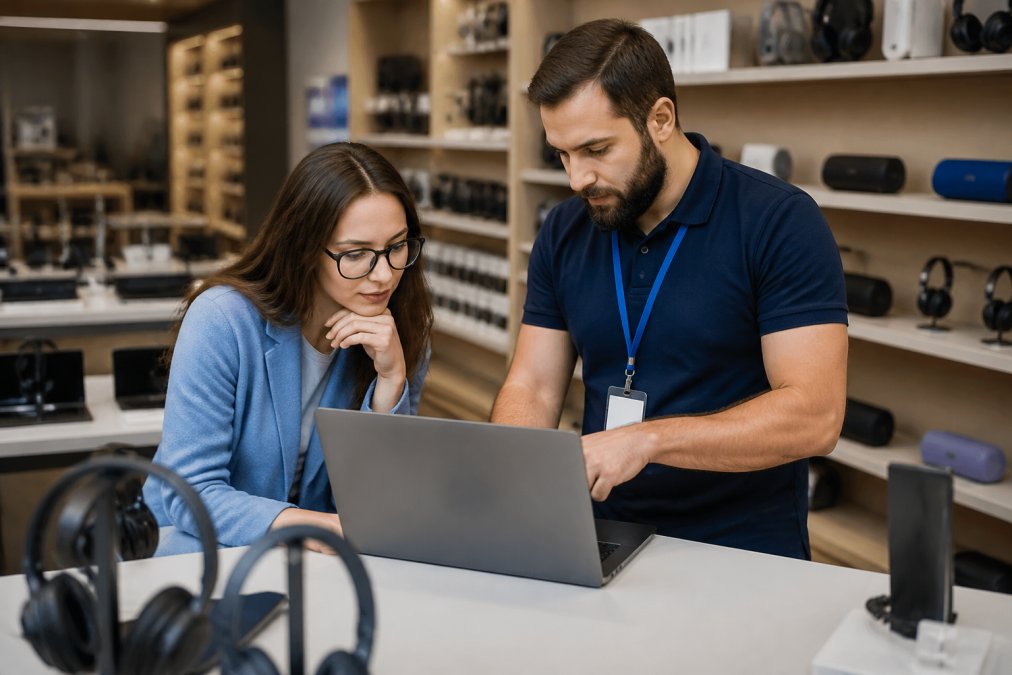
This expertise becomes critical with connected ecosystems. Smart home devices, for instance, often fail not because they are defective but because they use different communication protocols. A specialist who has configured dozens of setups can tell you immediately whether a new security camera will pair with your existing hub. Research published in Nature's study on retail technologies that enhance the customer experience confirms that retailers are increasingly using technology to create differentiated customer experiences, and that differentiation starts with knowledgeable staff.

The practical test is simple. Ask a generalist cashier whether a specific laptop can handle video calls, multiple browser tabs, and light design work simultaneously. Then ask a specialist, who will ask about your RAM requirements, storage needs, and whether you plan to dock the laptop to an external monitor. That conversation is the value you are paying for.
Tech Retailer Return Policy Comparison: What to Look For
Return policies are a legal contract, not just a courtesy. Federal law does not mandate a return period, so each retailer sets its own terms. The Federal Trade Commission's Cooling-Off Rule only applies to sales made at your home or a location that is not the seller's permanent place of business, meaning most electronics purchases fall outside its protection. That makes the retailer's written policy your only safety net.
A meaningful comparison goes beyond the headline return window. You need to read the fine print on restocking fees, return shipping responsibility, and how the retailer handles items that fail after the return window closes. The table below shows the specific clauses you should look for and why they matter for high-end electronics.
| Policy Clause | What to Look For | Why It Matters | Red Flag Example |
|---|---|---|---|
| Return window | 30 days or longer from delivery date | Gives you time to test real-world compatibility with your existing devices | 14-day window that starts at shipment, not delivery |
| Restocking fee | None on opened items unless the product is returned with missing parts | A 15% restocking fee on a $1,499.99 laptop costs you $225 just for changing your mind | 15% fee on all opened items, even if defective |
| Return shipping | Prepaid label provided at no cost | You should not pay to send back a product that does not work for your setup | Customer pays return shipping, deducted from refund |
| Refund method | Full refund to original payment method, not store credit | Store credit locks you into that retailer even if you are dissatisfied | Refund issued as store credit only |
| Defective item handling | Immediate cross-ship replacement or advanced replacement | Minimizes downtime when your primary work device fails | Retailer requires you to send the item in for inspection, then waits 7-10 business days before shipping a replacement |
| Warranty claim process | Retailer handles the claim directly with the manufacturer | You avoid the frustrating back-and-forth between retailer and manufacturer | Retailer gives you the manufacturer's phone number and ends their involvement |
State consumer protection laws add another layer. Some states, like California, require retailers to disclose their return policy clearly at the point of sale. A specialized retailer typically posts its full policy on the product page and order confirmation, not just buried in a terms-of-service page.
The practical test is to ask a retailer directly: "If this GPU does not work with my motherboard, who handles the return and how long does it take?" A generalist will often read from a script about contacting the manufacturer. A specialist will tell you their internal process, including who inspects the returned item and how quickly they issue a replacement.
Best Practices for Buying High-End Tech: A Checklist
Most buying guides stop at the sticker price, but the real cost of a high-end device includes maintenance, upgrades, trade-in value, and troubleshooting time. Use this checklist to evaluate not just whether a product fits your needs today, but whether the retailer helps you extend the life of your investment.
- Define your use case first: A laptop for video conferencing and light design work has different requirements than one built for competitive gaming. Write down the three most demanding tasks you will perform, then verify the device meets those specific requirements.
- Verify compatibility with existing equipment: Check ports, protocols, and power requirements against what you already own. A specialist can confirm whether a new GPU fits your motherboard's PCIe slot and power supply wattage before you buy.
- Research the retailer's support model: Will you speak with a product specialist or a general call center? Ask for the average hold time and whether the support team has hands-on experience with the specific product category.
- Read the return policy for restocking fees: High-end items often carry hidden restocking charges at general retailers. A 15% restocking fee on a $1,299.99 monitor is $195 you will not get back if the panel has a dead pixel.
- Compare total cost of ownership, not just purchase price: Factor in shipping, extended warranty costs, and potential return shipping fees. A device that costs $50 more from a specialist but includes a 2-year warranty and free return shipping often costs less overall than a bargain-price unit from a generalist with a $25 restocking fee.
- Ask about trade-in and recycling programs: A retailer that offers trade-in credit for your old device reduces the net cost of your upgrade. Ask whether the trade-in value is applied immediately or after inspection, and whether the retailer recycles devices that have no trade-in value. Responsible e-waste handling matters because lithium batteries and circuit boards contain hazardous materials that should not end up in a landfill.
- Confirm post-purchase support: Does the retailer help with setup or configuration questions? Some specialists offer free setup assistance for smart home hubs or vehicle tech installations, which can save you hours of trial-and-error.
- Check for member benefits: Some retailers offer gift card rewards or exclusive pricing for repeat customers. These programs can offset the price difference between a specialist and a generalist over multiple purchases.
- Ask about firmware and update support: High-end devices often need firmware updates to fix bugs or add features. A specialist who tracks these updates and can tell you whether a known issue affects your specific model is worth more than a generalist who does not know the product line exists.
How AI and Personalization Are Reshaping Specialty Retail
Artificial intelligence has moved from behind-the-scenes operations to the front line of the shopping experience. Insider One's 2026 retail technology analysis notes that AI is now defining the front-end customer experience, with hyper-personalization and AI shopping assistants becoming standard expectations rather than differentiators.
For consumers, this means product recommendations that actually match your needs. An AI-powered assistant that knows you work from home, use a MacBook, and need a monitor with USB-C power delivery will surface different options than one optimized for a gamer building a desktop rig. The Ryder 2026 E-commerce Consumer Study found that 64% of shoppers now use AI-powered shopping tools, signaling that consumers expect this level of guidance.
Specialized retailers are uniquely positioned to use AI effectively because they have clean, focused data. A general retailer's algorithm must account for everything from lawn mowers to laptops, diluting the quality of recommendations. A specialist's AI, trained only on consumer electronics and their ecosystem, can deliver genuinely useful suggestions. This is the Grand View Research smart retail market analysis in action: a market projected to grow from $68.8 billion in 2026 to $450.7 billion by 2033, driven by retailers who integrate intelligence into every customer touch point.
The Hidden Advantages: Data Privacy and Sustainability
Two factors rarely discussed in buying guides deserve your attention: how retailers handle your data and what happens to your old electronics.
Data privacy standards matter more than most shoppers realize. When you buy a smart home device, you are trusting a retailer and manufacturer with data about your daily routines, your home's entry points, and your network. Specialized retailers typically maintain stricter data handling standards because their reputation depends on trust within a niche community.
Sustainability and e-waste management is the second hidden advantage. Consumer electronics have a finite lifespan, and responsible retailers offer guidance on recycling, trade-in programs, and disposal of hazardous components like lithium batteries. A retailer who helps you extend the life of your devices reduces your long-term cost of ownership.
The transformation challenge identified in Slalom's 2026 Retail Industry Trends report applies here: retailers must balance rapid technological shifts with human-plus-machine teams to drive genuine loyalty. Specialized retailers who pair AI-driven recommendations with human expertise create the high-touch, tech-enabled service model that earns repeat business.
Conclusion: Making the Smart Choice for Your Next Purchase
The decision of where to buy high-end technology shapes your entire ownership experience, from the initial setup to the moment you need support. Choosing a specialized tech retailer means prioritizing expert guidance, transparent return policies, and long-term value over the lowest possible upfront price.
At TechyDealy, we combine curated product selection with complimentary ground shipping and a hassle-free return policy on every order, so you can shop with confidence knowing your purchase is protected. Our focus on high-quality gadgets, gaming gear, and smart home solutions means the expertise is built into every recommendation. Shop Smart Essentials and make your next tech purchase the one you finally get right.
Frequently Asked Questions
Are specialized tech retailers more expensive than big-box stores?
Not necessarily. While the sticker price on some items may be similar, specialized retailers often provide value that offsets cost differences. This includes expert guidance that helps you avoid buying incompatible or unnecessary accessories, and post-purchase support that saves you time and money. When you factor in the long-term cost of ownership, including avoiding costly mistakes, specialized tech retailers can be the more economical choice.
How does specialized tech support differ from general retail support?
Specialized tech support focuses on your specific device ecosystem and use case. Staff at specialized retailers like TechyDealy are trained to answer detailed questions about compatibility, performance, and setup. General retail support often relies on basic product specs and may not understand how different devices integrate. This expertise is critical when setting up a smart home system or choosing a high-performance gaming laptop, where the importance of expert tech support directly affects your satisfaction.
What should you look for when choosing an electronics retailer?
Focus on three key areas: product selection depth, return policy, and post-purchase support. A specialized retailer should stock items curated for quality and compatibility, not just volume. Review their return window and restocking fees before you buy. Finally, check if they offer expert tech support after your purchase. Following these best practices for buying high-end tech ensures you get a device that works for years, not just days.
Do specialized tech retailers offer better warranty and return policies?
Specialized tech retailers often provide more flexible and customer-friendly return policies than big-box stores. They understand that setting up complex tech can take time, so they offer generous return windows and hassle-free processes. For example, TechyDealy offers a full purchase price refund and covers return shipping costs. This reduces the risk of buying high-end devices, making a tech retailer return policy comparison a crucial step before any major purchase.